
Impact driver vs combi drill: what each is for, and do you need both?
Affiliate Disclosure: As an Amazon Associate we earn from qualifying purchases. This doesn't affect our editorial independence — every recommendation is based on genuine research and analysis.
This page contains Amazon affiliate links. If you buy through them we may earn a small commission at no extra cost to you.
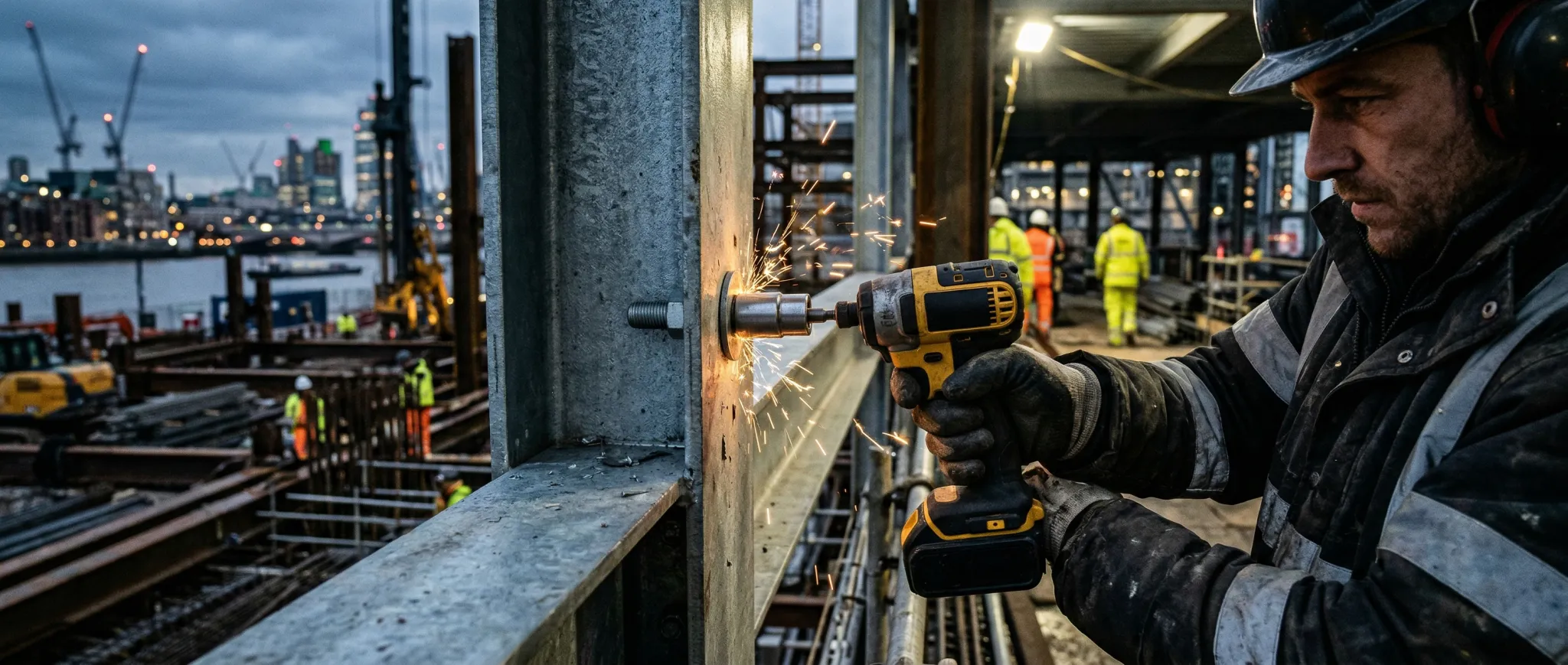
An impact driver is for driving screws and bolts, fast, all day, without wrecking your wrist. A combi drill is for drilling holes and for driving screws when you need to stop at a set depth. If you are a carpenter, joiner or decking fitter you want both, and most twin kits are sold that way for a reason. If you can only afford one and you mostly drill, buy the combi. If you mostly drive long screws into timber, buy the impact driver and borrow a drill.
How an impact driver works
Inside an impact driver there is a hammer and anvil. When the screw starts to resist, the hammer winds up against a spring, lets go and strikes the anvil sideways, in the direction of rotation, thousands of times a minute. Those short rotational hits are what drive a 150 mm timber screw home without the tool trying to twist out of your hand. Most of the force goes into the screw and very little comes back into your arm.
The headline numbers reflect that. The impact drivers we list run from about 175 Nm for the compact Makita up to around 220 Nm for the Milwaukee M18 FUEL, according to the manufacturers. A typical 18V combi quotes 40 to 60 Nm. That does not make the impact driver a better drill. Torque in an impact driver is delivered in bursts, and the figures are not measured the same way, so do not compare them like for like.
How a combi drill works
A combi drill turns smoothly, with no impacts in drill mode, and has a clutch: the numbered ring behind the chuck. Set it low and the clutch slips when the screw reaches a set resistance, so every hinge screw stops flush and nothing strips. It also has a hammer setting for masonry and a 13 mm keyless chuck that takes round-shank bits, flat bits, hole saws and augers.
Side by side
| Impact driver | Combi drill | |
|---|---|---|
| Chuck | 1/4 inch hex quick release | 13 mm keyless, any shank |
| Clutch | No (speed or drive modes instead) | Yes |
| Long screws in timber | Best tool | Hard work, kicks back |
| Small screws in hinges and hardware | Easy to overdrive | Best tool |
| Holes in timber | Small holes with hex bits | Best tool, up to big augers |
| Holes in masonry | No | Yes, in hammer mode |
| Noise | Loud when impacting | Quieter |
| Size | Usually shorter and lighter | Longer |
The jobs a carpenter gives each one
Impact driver: first fix studwork, joist hangers, decking, fence panels, coach screws into posts, roofing battens, long screws in sole plates, nuts on threaded bar with a socket adaptor. Anything where the screw is long and the only goal is to get it home.
Combi drill: pilot holes, clearance holes, countersinking, hinges, cabinet fixings, worktop bolts, kitchen handles, anything in hardwood that might split, anything with a soft brass screw, and the hammer-mode plug holes to fix a batten to a block wall.
The split is so clean that most carpenters run a drill bit in the combi and a driver bit in the impact all day, swapping tools rather than bits. That is the strongest argument for owning both.
Where impact drivers go wrong
No clutch. On small screws an impact driver will snap the head off, strip the head or bury the screw. The better models soften this with modes: Milwaukee's M18 FUEL has four drive control modes, DeWalt's DCF887 has three speed settings and Makita's DTD157 has four. Learn the low setting and feather the trigger. They still will not stop at a set torque the way a clutch does.
Bits. Impacting destroys ordinary screwdriver bits. Buy impact-rated bits, which have a torsion zone that flexes and lasts much longer. Cheap bits in an impact driver are where most cam-out complaints in owner reviews start.
Noise. On an occupied job, a kitchen refit or a flat with neighbours, an impact driver at full chat in a timber stud wall is loud. Ear defenders on a long day are not overkill.
The impact drivers worth looking at
DeWalt DCF887 18V XR Brushless, around £150. 205 Nm by DeWalt's figure, three speeds, three LEDs round the nose, 116 mm long. The safe default if you are on DeWalt batteries, and our pick for carpenters.
Milwaukee M18 FUEL Impact Driver, around £190. The most torque in this list, 220 Nm quoted, and the drive control modes, including a self-tapping screw mode for metal, are the most useful of any brand.
Makita DTD157 18V LXT, around £140. A 105 mm body is the shortest here, for working inside cabinets and between joists. 175 Nm is plenty for timber.
Bosch Professional GDX 18V, around £130. Takes 1/4 inch hex bits and has a 1/2 inch square drive for sockets, so it doubles as a light impact wrench for coach bolts and wheel nuts on a trailer.
Ryobi ONE+ 18V Impact Driver, around £80. For a second driver on the van or for someone building a shed.
For the drill half of the pair, the combi drills for carpenters list has the brushless models, and the best impact drivers for carpenters post goes model by model for joinery.
What we'd buy
A twin kit from the platform you already own: brushless combi plus brushless impact driver, two batteries, one charger. It is almost always cheaper than buying the two separately. If you are choosing a platform from scratch, read the 18V platforms comparison first, because the batteries are the expensive bit and you will be living with them for years.
Frequently asked questions
Can an impact driver replace a combi drill?
Not fully. An impact driver drives screws and small hex-shank drill bits very well, but it has no clutch, no 13 mm chuck for round-shank bits and no hammer mode for masonry. You can get by with one on a decking or fencing job. For general carpentry you will miss the combi's control on hinges and hardware within a day.
Is an impact driver better than a drill for screws?
For long screws in timber, yes. The rotational impacts drive 100 to 150 mm screws easily without the tool twisting against your wrist. For small screws in hinges, handles and cabinet fixings a combi drill with its clutch set low is better, because an impact driver has no clutch and will overdrive or snap small screws.
Do I need special bits for an impact driver?
Yes, use impact-rated bits. They have a torsion zone that flexes slightly under each blow, so they last far longer than ordinary screwdriver bits and cam out less. Ordinary bits will shatter or round off quickly. Drill bits for an impact driver need a 1/4 inch hex shank to fit the quick-release chuck.
Why is an impact driver's torque so much higher than a drill's?
Because it is delivered in short rotational hits rather than as steady turning force. An impact driver may quote around 200 Nm and a combi 40 to 60 Nm, but the figures are measured differently and are not directly comparable. The high peak torque is why an impact driver sinks long screws so easily without kicking back.
Should I buy a twin kit or separate tools?
Buy a twin kit if you are starting out or switching platforms. A combi drill and impact driver sold together with two batteries and a charger usually costs less than buying them separately. If you already own batteries, buying body-only tools on the same platform is cheaper still.
Top picks: Impact Drivers for Carpenters
Ranked from our research and cross-referenced buyer reviews. Prices change, so check the current price on Amazon.

Impact Drivers
DeWalt DCF887 18V XR Brushless Impact Driver
Around £149.99
Check price on Amazon
Impact Drivers
DeWalt 18V XR Cordless Impact Driver Kit
Around £179.99
Check price on Amazon
Impact Drivers
Bosch Professional GDX 18V Impact Driver/Wrench
Around £129.99
Check price on AmazonRelated Reviews
Browse All Impact Drivers
10 products reviewed with buying guides
Affiliate Disclosure: As an Amazon Associate we earn from qualifying purchases. This doesn't affect our editorial independence — every recommendation is based on genuine research and analysis.